








MeRT


Brain Treatment Center sign on the wall

Developmental Delay

The path to a hopeful future will be opened

We are committed to brain health & healing.

플로리다 맥딜 공군기지 로고
블리처 리포트 로고
디펜스원 로고
더 닥터스 로고
nbc 스포츠 로고
글로벌 sof 로고
워싱턴 포스트 로고
월스트리트 저널 로고

Our Approach

Personalized Treatment Process

No two brains are alike. And no two treatments should be either.

01

Evaluate

Evaluate

Using qEEG · EKG, we check neural function and safety to create a personalized 'functional map'.

02

Design

Design

Our medical team designs stimulation location, intensity, and method uniquely for each patient.

03

Apply

Apply

rTMS-based non-invasive adjunctive treatment. Designed to fit into your daily life.

04

Review

Accompany

The medical team and guardians together review progress and decide the next step.

MeRT is not intended to treat or cure any specific condition. It is applied as an adjunctive treatment based on medical judgment and the informed consent of patient or guardian.

FAQs
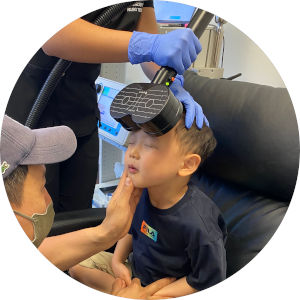
A child receiving MeRT treatment seated with the device on their head

How we help

Developmental Delay

"We tried every possible treatment to help our child, but nothing made a real difference — until we discovered BTC by chance, and MeRT changed everything for our family."

BTC Patient

A mother and daughter seated at a desk reading a book together

Results that "Speak"

66% of individuals experienced speech improvement

In a double-blind randomized controlled trial, 66% of individuals with verbal and non-verbal communication difficulties experienced improvement in communication.

A mother resting her forehead against her daughter who is seated on the bed

Stay Focused

70% of individuals improved eye contact behavior

In the same study, 70% of individuals who had difficulty maintaining eye contact showed improvement in eye contact.

The MeRT℠ Approach

Even with the same diagnosis, symptoms and causes differ by individual — because every brain is structured differently.

Understanding that each patient is treated uniquely is essential. Treatment begins by identifying regions of impaired interaction within an individual's brain. Those identified regions are specifically targeted to improve and strengthen function.

About MeRT℠
Illustration of electromagnetic waves passing through the brain in up-and-down waveforms

Developmental Delay Brain Patterns

EEG measurements can identify reduced alpha-wave activity and interconnectivity in the frontal lobe.

Patients with developmental delay often show characteristic markers across roughly the front three-quarters of the brain. These EEG patterns are dominated by slow waves (delta and theta) and fast waves (beta), while neurotypical patterns are usually dominated by alpha activity.

By measuring EEG and using that data to generate a unique personalized treatment protocol, we can improve frontal-region function and overall brain coherence. This approach has been associated with improvements in sleep, social behavior, and quality of life for both children and their families.

Frequently Asked Questions

How long does the qEEG·EKG evaluation take?

Typically completed within 30–60 minutes. Time varies by patient cooperation and condition; the medical team allows sufficient time for safe completion.

Is the same treatment applied to every patient?

No. Rather than a standard protocol, stimulation location, intensity, and method are designed individually based on qEEG results.

How long is a single treatment session?

A session typically takes 30–60 minutes. Actual stimulation is brief; the rest is preparation and observation time.

Is anesthesia or recovery time required?

No. MeRT is non-invasive and painless. Patients can return to daily life immediately after a session.

Can guardians be present during sessions?

Yes. Especially for pediatric patients, treatment is conducted with the guardian's informed consent, and they may accompany during sessions.

How is treatment progress monitored?

qEEG is re-measured periodically during treatment to track changes in brain function. The medical team and guardian together review behavioral, emotional, and daily-life changes to decide the next step.